Buying a website means paying for a site that already has content, traffic and income, instead of building one from zero. You skip the slow first year, but you take on the risk that the site is not what the seller says.
This guide covers where to find websites for sale, how they’re priced, and the checks to run before you pay anything.
Why buy instead of build?
- Time: a site with a year of content and rankings is a year you don’t have to wait.
- Proof: you can see what already earns, instead of guessing.
- Upside: many sites are under-managed. More content, better affiliate offers or a better ad network can grow the income.
The trade-off is cost and risk. Building is cheap but slow; buying is fast but needs cash and careful checking.
Where to find websites for sale
| Marketplace | Best for | Notes |
|---|---|---|
| Motion Invest | Small content sites, starter sites | Focuses on content sites, roughly $1,000 to $100,000. Sites under $2,000 are paid in full; above that, a $1,000 deposit holds the site. |
| Flippa | Widest range, all sizes | Open marketplace with everything from starter sites to large businesses. Quality varies; check carefully. Payments run through Escrow.com. |
| Empire Flippers | Established, vetted businesses | Curated listings, higher prices. About half its listings are priced below $300,000. |
You can also buy privately by emailing owners of sites you like. Private deals can be cheaper but have no marketplace protection, so use escrow and a written agreement.
How websites are priced
Most sites sell for a multiple of their profit. The basic formula:
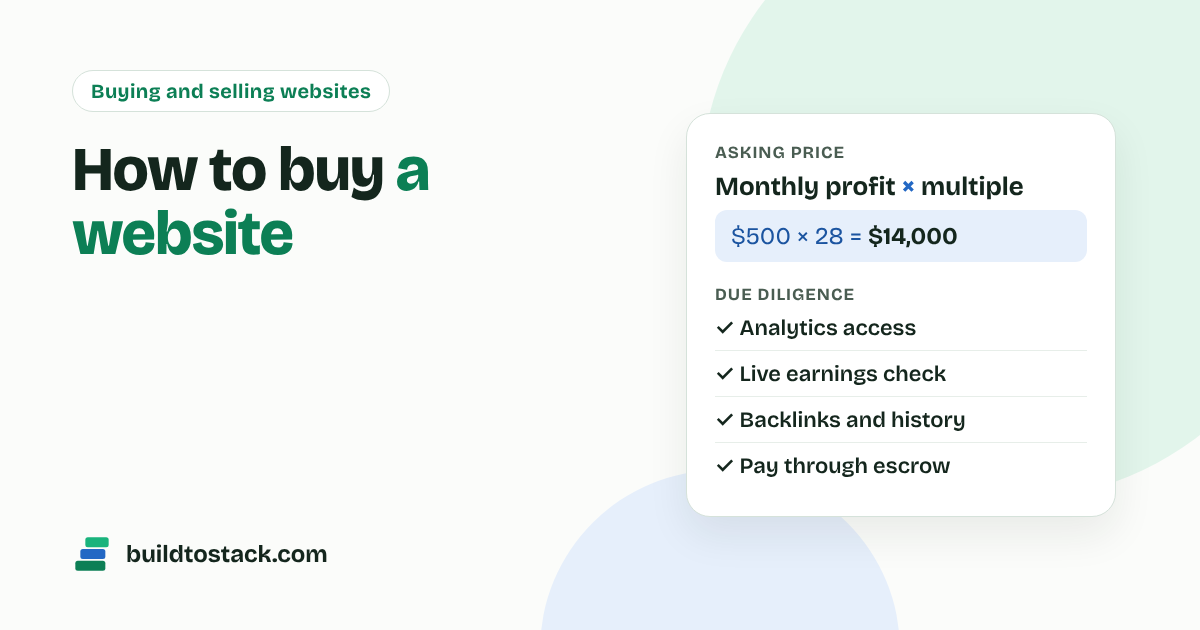
Price = average monthly net profit × multiple
The average is usually taken over the last 12 months, which smooths out seasonal swings. Empire Flippers now shows multiples per year: since September 2026, a typical business there lists at about 2.3 times its yearly profit, roughly 28 times monthly profit. Premium businesses list at about 2.6 times yearly profit.
What pushes the multiple up or down:
| Higher price | Lower price |
|---|---|
| Several years of steady or growing income | Short history or falling income |
| Traffic from several sources | All traffic from one Google keyword or one social account |
| Several income streams | Depends on one affiliate programme |
| Little work needed each month | Owner works on it full time |
| Clean, original content and natural links | Thin content, bought links, AI spam |
Example: a site making $500 a month in profit, at 28 times monthly profit, would be priced around $14,000.
Due diligence checklist
Due diligence means checking everything before you pay. Never skip it, even on cheap sites.
Traffic
- Get view access to Google Analytics and Search Console, not screenshots.
- Check the traffic trend for at least 12 months. Is it growing, flat or falling?
- Compare traffic drops with dates of Google updates. A site hit by recent updates may keep falling.
- Check which pages and keywords bring most traffic. Is it spread out or concentrated?
Income
- Ask the seller to log in to each earnings dashboard (AdSense, Amazon, networks) on a live video call while you watch.
- Match earnings to the profit and loss statement month by month.
- Confirm every affiliate account and ad network can be moved to you or replaced.
Content and links
- Copy a few paragraphs into Google in quotes to check they’re not copied from elsewhere.
- Check the domain’s history on the Wayback Machine. Was it ever something unrelated or spammy?
- Check backlinks with a free tool such as Ahrefs’ backlink checker. Lots of spammy or paid-looking links are a warning sign.
The deal
- Pay through escrow or the marketplace, never directly to a stranger.
- Get a written list of what’s included: domain, content, email list, social accounts, logos.
- Agree on a short support period where the seller answers questions after the sale.
Red flags that should stop a deal
- The seller won’t give access to Analytics or a live view of earnings.
- Income jumped suddenly in the last few months before the sale.
- Traffic comes mostly from one source you can’t keep, like the seller’s personal social media.
- The price is far below similar sites with no clear reason.
- The seller pushes you to decide fast or pay outside escrow.
What to do after you buy
- Change every password and move the domain to your own registrar account.
- Move hosting, or at least take full ownership of the hosting account.
- Swap in your own affiliate and ad accounts.
- Don’t change everything in week one. Watch traffic for a month, then improve.
- Fix quick wins first: old articles, broken links, slow pages, missing internal links.
Start small
Your first purchase is mostly an education. A small starter site lets you learn the transfer process and the work involved without risking much. Once you’ve grown one site, you’ll know far better what a good deal looks like.
Not ready to buy? Building is the cheaper way to learn. Read How to Make Money With a Website and get the free starter kit on the homepage.