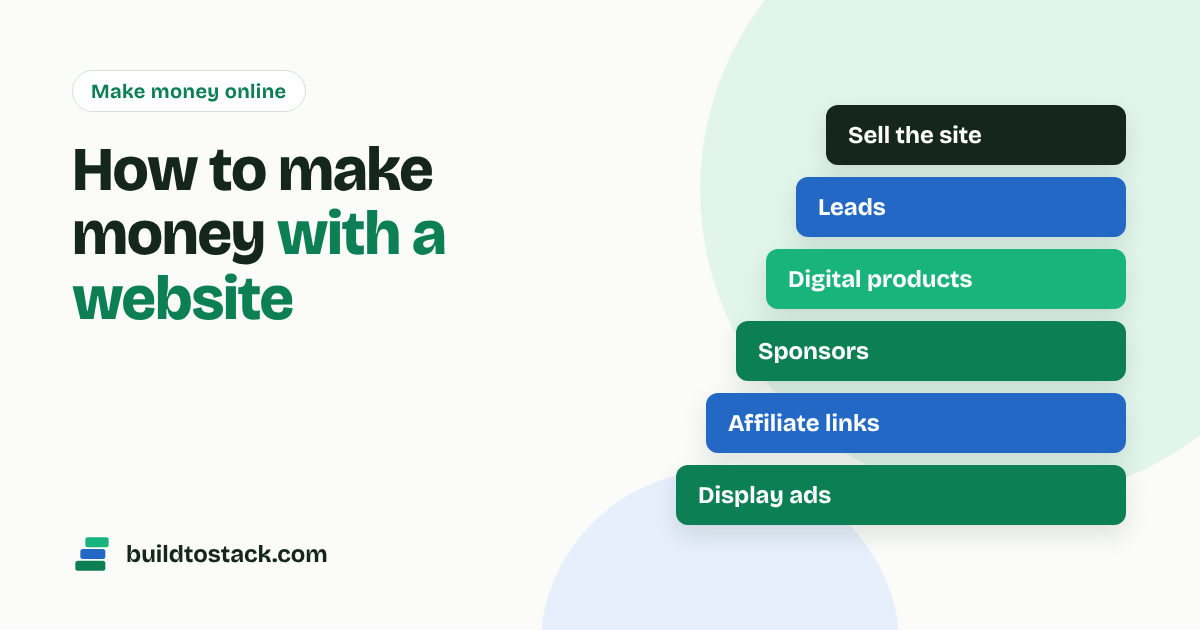
A website makes money in one of six ways: it shows ads, sends readers to products through affiliate links, gets paid by sponsors, sells its own products, sells leads, or gets sold as a whole. Most successful sites combine two or three of these.
The common thread is traffic from people who are looking for something. Get that, and every method below becomes possible. This guide explains each one, what it pays, and which to start with.
1. Display ads
Display ads are the banners and in-content ads you see on blogs. You add a code snippet to your site, an ad network fills the space, and you earn a share of what advertisers pay.
The easiest place to start is Google AdSense. Google says publishers keep roughly 68% of ad revenue overall, and AdSense now pays mainly per impression rather than per click.
Ads earn per 1,000 visits, so income grows with traffic. A small site earns little from ads; a site with tens of thousands of monthly visitors can earn a steady amount. Topics with expensive advertisers, like finance, insurance and software, pay more per visit than topics like recipes or entertainment.
When your traffic grows, premium ad networks such as Mediavine and Raptive usually pay more than AdSense. Each has its own traffic requirements, so check their sites when you get there.
Best for: sites that answer lots of questions and get many visitors.
2. Affiliate marketing
With affiliate marketing, you recommend a product and earn a commission when a reader buys through your link. You don’t handle stock, payments or support.
Commission rates vary a lot. Amazon Associates pays between 1% and 10% depending on the category: for example, 3% on toys and home products and 10% on luxury beauty. Software and online services often pay 20% to 40%, sometimes every month the customer stays.
Affiliate content works best when the reader is close to buying. Think “best running shoes for flat feet”, “Hostinger vs Bluehost” or “is Semrush worth it”. Read Affiliate Marketing for Beginners for the full setup.
Best for: topics where people buy things: tech, software, home, fitness gear, travel, finance products.
3. Sponsored posts and sponsorships
Once your site has an audience, brands may pay you to review their product or feature them. Prices depend on your traffic and how well you match the brand.
Two rules keep this safe. Always label sponsored content clearly for readers. And mark paid links with rel="sponsored", as Google asks, so they don’t count as link schemes.
Best for: established sites in a clear niche.
4. Your own digital products
A digital product is something you make once and sell many times: an ebook, a template, a spreadsheet, a course or a paid community. You keep most of the money, unlike ads or affiliate commissions.
The catch is that you need trust first. Most people won’t buy from a site they found five minutes ago. That’s why many site owners build an email list early: subscribers get to know you, and some buy later.
Best for: sites with an email list and a clear problem you can solve.
5. Lead generation and services
Some sites earn by sending enquiries to businesses. A guide to roof repairs can pass leads to a roofing company. A guide to SEO can lead to clients for your own SEO service.
Lead deals are usually agreed directly with a business, per lead or per month. This works especially well for local services and business-to-business topics.
Best for: service topics where one customer is worth a lot.
6. Selling the website
A website that makes steady profit is an asset you can sell. Marketplaces price sites as a multiple of profit. On Empire , Flippers, a typical business lists at about 2.3 times its yearly profit, roughly 28 months of profit.
This is the “stack” in Build to Stack: build a site, grow its income, then either keep it or sell it and build the next one. See How to Buy a Website for how the buying side works.
Which method should you start with?
Start with a site that answers questions in one topic, then add money as traffic arrives. A sensible order:
- Pick a topic where people search for answers and buy things.
- Publish helpful articles that target real searches. Start with SEO for Beginners.
- Add affiliate links to buying-focused articles from day one.
- Apply for AdSense once you have a good number of useful posts and visitors.
- Collect emails from the start, so you can sell your own products later.
How long does it take?
Expect months, not weeks. New sites often wait several months before Google sends steady traffic, and income follows traffic. The people who succeed keep publishing through that quiet period.
A realistic first goal is your first dollar, not your first thousand. Once one article earns, you know what to make more of.
Common mistakes to avoid
- Choosing a topic only for money. You’ll need dozens of articles; pick something you can write about for a year.
- Writing what you want, not what people search. Use keyword research to find real questions.
- Adding too many ads too early. Slow, cluttered pages lose readers.
- Buying cheap links or mass-producing AI articles. Google’s spam policies target both, and a penalty can wipe out a site.
- Quitting at month three. This is exactly when most sites are about to start growing.
Get the free starter kit
The Build to Stack starter kit walks you through choosing hosting, setting up WordPress, the plugins to install, free keyword tools, and how AdSense and affiliate programmes work, with screenshots. Enter your email on the homepage and it’s in your inbox in a minute.
2 comments