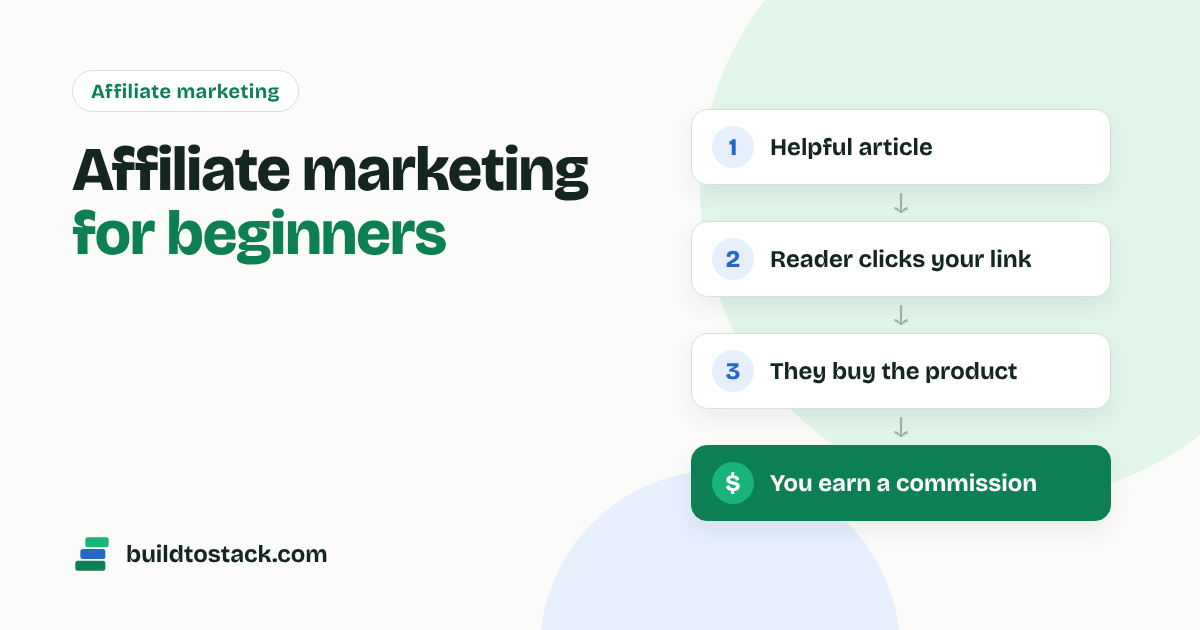
Affiliate marketing means earning a commission when someone buys a product through your link. You recommend, the reader buys, the company pays you a share. You never touch stock, payments or customer support.
It’s one of the best ways to earn from a content website, because the right article can earn for years after you write it. Here’s how it works and how to start.
How affiliate marketing works
- You join a company’s affiliate programme and get a unique tracking link.
- You add the link to a helpful article, like a review or a comparison.
- A reader clicks it. A small file called a cookie records that they came from you.
- If they buy within the tracking window, the sale is credited to you.
- The company pays your commission, usually monthly, once you pass a minimum amount.
The tracking window (or cookie duration) matters. Amazon credits you for purchases made within 24 hours of the click. Many software companies track for 30 to 90 days.
How much affiliates earn
Your income depends on three numbers: how many people click, how many buy, and what you earn per sale.
Commission rates vary widely by programme:
| Programme type | Typical commission | Example |
|---|---|---|
| Big online stores | 1% to 10% of the sale | Amazon: 3% on home products, 10% on luxury beauty (source) |
| Software and online tools | 20% to 40%, sometimes recurring | hosting, email marketing, SEO tools |
| Courses and digital products | 30% to 50% | online courses, ebooks, templates |
| Finance and insurance | fixed amount per sign-up | credit cards, accounts, quotes |
A high percentage on a cheap product can earn less than a low percentage on an expensive one. 3% of a $600 sofa is $18; 10% of a $30 serum is $3.
Where to find affiliate programmes
Start with products your readers already use. Search Google for “[product name] affiliate program”, or scroll to the footer of a company’s website, where the affiliate link usually sits.
Affiliate networks list thousands of programmes in one place:
- Amazon Associates: almost any physical product. Low rates, but readers trust Amazon and buy easily. Note the rule that new accounts must make qualifying sales within their first 180 days.
- Impact: large brands across software, retail and travel.
- CJ: big retail, travel and finance brands.
- Awin: a big global network, especially strong in Europe. It now includes the former ShareASale brands.
- PartnerStack: software (SaaS) companies, many with recurring commissions.
- ClickBank: digital products with high commissions. Check product quality carefully before promoting.
Before joining, check the commission, the tracking window, the payout threshold and how they pay in your country.
The content that earns commissions
Affiliate income comes from readers who are close to buying. These article types work best:
- “Best X for Y” lists: “best laptops for students”, “best web hosting for beginners”.
- Reviews: an honest, detailed look at one product, with pros and cons.
- Comparisons: “Semrush vs Ahrefs”, “Hostinger vs Bluehost”.
- Alternatives: “cheaper alternatives to Canva Pro”.
- How-to guides that need a tool: “how to start a podcast” naturally needs a microphone and hosting.
The articles that earn are the ones that help people decide. Show the product in use, explain who it’s not for, and give a clear recommendation. Thin lists of products with links rarely rank or convert.
How to start, step by step
- Pick a topic where people buy things. Fitness gear, software, home office, travel and personal finance all work.
- Build a simple WordPress site with an About page, a Privacy page and an affiliate disclosure page.
- Write 5 to 10 helpful guides before applying to stricter programmes. Many review your site first.
- Join a network and one or two direct programmes that fit your topic.
- Write buying-focused articles and add your links where they genuinely help.
- Track clicks and sales in each dashboard, then write more of what earns.
Follow the disclosure rules
Tell readers when you earn from a link. In the US, the FTC’s Endorsement Guides require clear disclosure of paid relationships, and many other countries have similar advertising rules. Amazon also requires its own statement on your site.
In practice:
- Put a short line near the top of any post with affiliate links: “We may earn a commission if you buy through links on this page, at no extra cost to you.”
- Keep a full disclosure page linked in your footer.
- Mark affiliate links with
rel="sponsored", as Google recommends. Rank Math and most link plugins can do this automatically.
Beginner mistakes
- Promoting products you know nothing about. Readers notice, and so does Google.
- Relying on one programme. Commission rates change; Amazon’s have been cut before. Spread across a few.
- Putting links everywhere. Use them where they help a decision, not in every paragraph.
- Ignoring email. Your list lets you recommend products to people who already trust you.
Next steps
Affiliate articles still need traffic, so pair this with SEO for Beginners. The free Build to Stack starter kit lists affiliate networks, where to find programmes and how payouts work, with screenshots. Get it on the homepage.